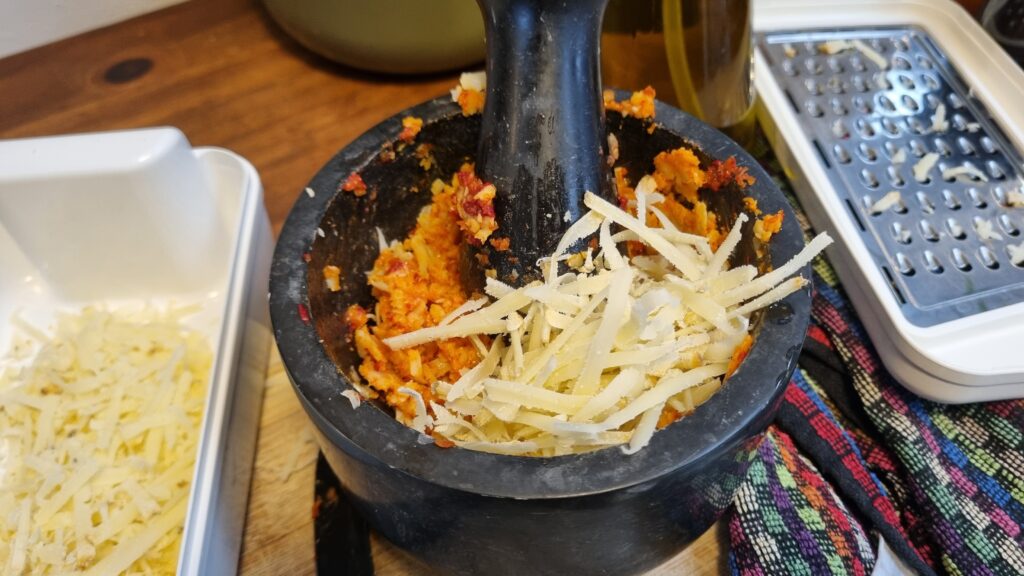
I made this for the first time on a cold January evening and it’s been on regular rotation ever since.
Pollo al salmorejo canario is chicken slow-cooked in a marinade of garlic, paprika, cumin, white wine and vinegar. The marinade — called the salmorejo — does most of the work. You make it, pour it over the chicken, leave it overnight, and the next day you have a dish that tastes like far more effort than it actually was.
One thing worth knowing before you search for this: the salmorejo in the Canary Islands has nothing to do with the cold tomato soup from Córdoba you might know from the mainland. Same word, completely different thing. Here it’s a wet spiced marinade — traditionally for chicken or rabbit (conejo) — and it’s one of the most traditional dishes on the islands.
About the dish
The flavour of pollo al salmorejo is distinctively Canarian: garlic-heavy with sweet paprika (pimentón dulce) and cumin (comino), sharpened with vinegar and wine. It’s definitely not subtle, but not overly rich either. The chicken cooks in the marinade, which reduces into a dark, intensely fragrant sauce.
The same recipe works with rabbit (conejo) — conejo al salmorejo canario is arguably the more traditional version. But chicken is easier to find (and many might say, tastier) and the method is identical.
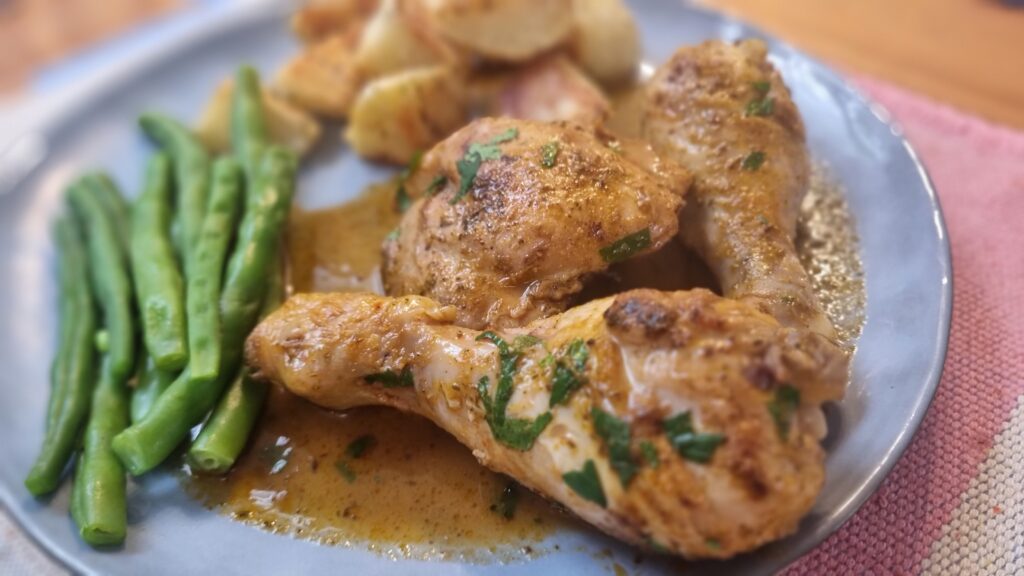
The marinade
The salmorejo is a wet paste, not a dry rub. Garlic is the base — you start by pounding it with salt in a mortar (mortero) until smooth, then build everything else on top. The garlic comes through clearly in the finished dish, so don’t hold back.
Paprika and cumin are what give this its character. Use sweet paprika (pimentón dulce) rather than smoked — smoked paprika isn’t traditional here and pulls the flavour in the wrong direction. Although, I do love adding a pinch of hot paprika to spice it up a bit.
No mortar? OR short on time? A small blender or food processor works fine. Make sure the garlic is properly puréed before you add anything else — chunks of raw garlic in the finished sauce are not what you want.
I use 200ml of white wine and 3 tablespoons of white wine vinegar. On the wine: you do notice the difference between a cheap cooking wine and something you’d actually drink. I used a cheap cooking wine this particular time and you do tell the difference. It doesn’t need to be expensive — a basic supermarket white at €3–5 is fine.
Apple cider vinegar works very well in place of white wine vinegar. I used it this time and couldn’t tell much difference in the finished dish. Red wine vinegar also works, though it changes the colour of the sauce slightly.
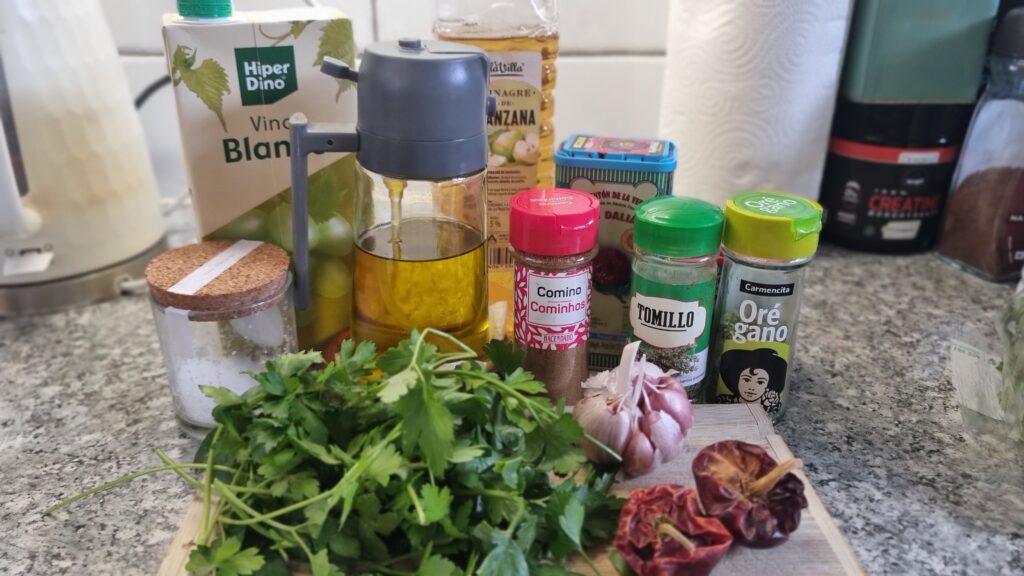
For the marinade (salmorejo)
- 6 cloves garlic, peeled
- 1 tsp fine salt (for the paste)
- 2 tsp sweet paprika (pimentón dulce)
- 1 tsp ground cumin (comino)
- 1 tsp dried oregano (orégano)
- ½ tsp freshly ground black pepper
- 200ml dry white wine — something drinkable
- 3 tbsp white wine vinegar (or apple cider vinegar)
- 4 tbsp olive oil
- 2 bay leaves (hojas de laurel)
For the chicken
- 1 whole chicken cut into quarters (pollo entero cortado en cuartos), approx. 1.2–1.5kg — or equivalent bone-in pieces
- Olive oil and salt for browning
You can use any bone-in pieces — thighs work particularly well. At the butcher (carnicería), ask for “un pollo entero cortado en cuartos, por favor.” I find that this is usually the most budget-friendly option and gives textural variety to the dish.
I use 200ml of white wine and 3 tablespoons of white wine vinegar. On the wine: you do notice the difference between a cheap cooking wine and something you’d actually drink. It doesn’t need to be expensive — a basic supermarket white at €3–5 is fine.
Apple cider vinegar works very well in place of white wine vinegar. I used it this time and couldn’t tell much difference in the finished dish.
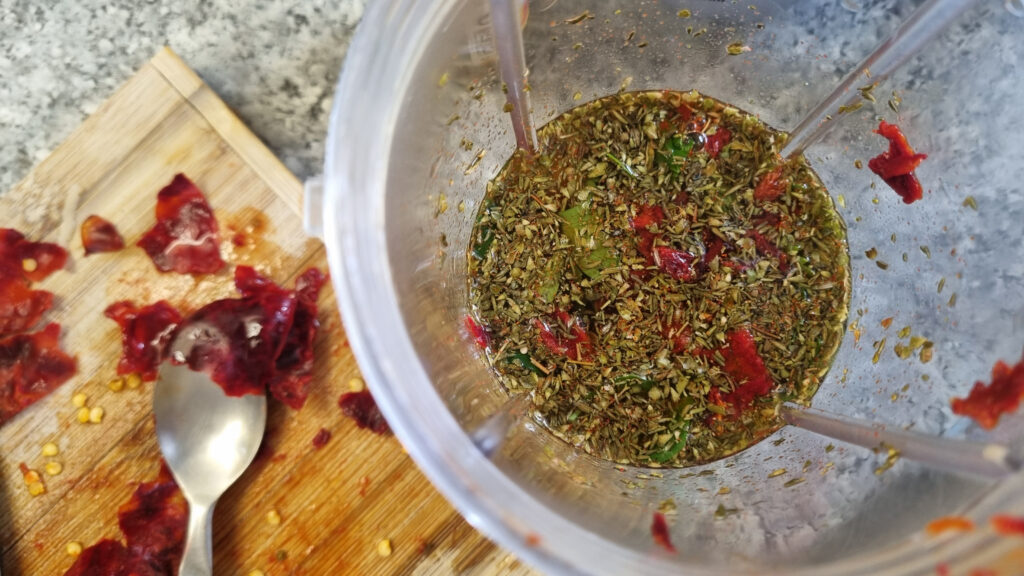
Once the ñoras are scraped, everything goes into a blender — garlic, ñora flesh, spices, wine, vinegar, olive oil. Blend until smooth. It’s quicker than a mortar and you get a better emulsion. If you prefer the mortar: pound the garlic and ñora flesh together first, then add the dry spices, then the liquids.
For the marinade (salmorejo)
- 6 cloves garlic, peeled
- 1 tsp fine salt
- 2 ñora peppers, rehydrated and flesh scraped out
- 2 tsp sweet paprika (pimentón dulce)
- ¼ tsp hot paprika (pimentón picante), to taste
- 1 tsp ground cumin (comino)
- 1 tsp dried oregano (orégano)
- ½ tsp freshly ground black pepper
- 200ml dry white wine — something drinkable
- 3 tbsp white wine vinegar (or apple cider vinegar)
- 4 tbsp olive oil
- 2 bay leaves (hojas de laurel)
For the chicken
- 1 whole chicken cut into quarters (pollo entero cortado en cuartos), approx. 1.2–1.5kg — or equivalent bone-in pieces
- Olive oil and salt for browning
You can use any bone-in pieces — thighs work particularly well. At the butcher (carnicería), ask for “un pollo entero cortado en cuartos, por favor.” Most butchers in the Canary Islands will do this without hesitation.
Marinating the chicken
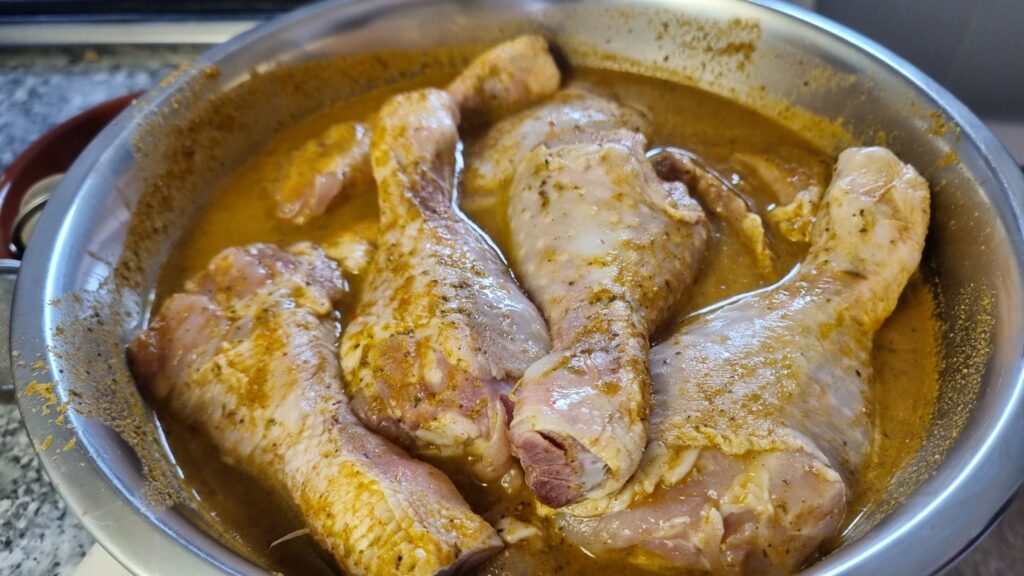
Make the marinade, pour it over the chicken, add the bay leaves, and leave it. Four hours is the minimum — you’ll get flavour but the marinade hasn’t fully penetrated. Overnight in the fridge is noticeably better as the meat gets more tender and the sauce has more depth.
If you’re making this for dinner, start the marinade the night before. It takes about 10 minutes.
Take the chicken out of the fridge 30 minutes before you cook it. Cold chicken straight into a hot pan drops the oil temperature, browning is much more difficult, and the cooking time becomes unpredictable.
Cooking it
Remove the chicken from the marinade and keep the liquid. Slightly pat the pieces dry — this is what lets you get a proper brown on the skin.
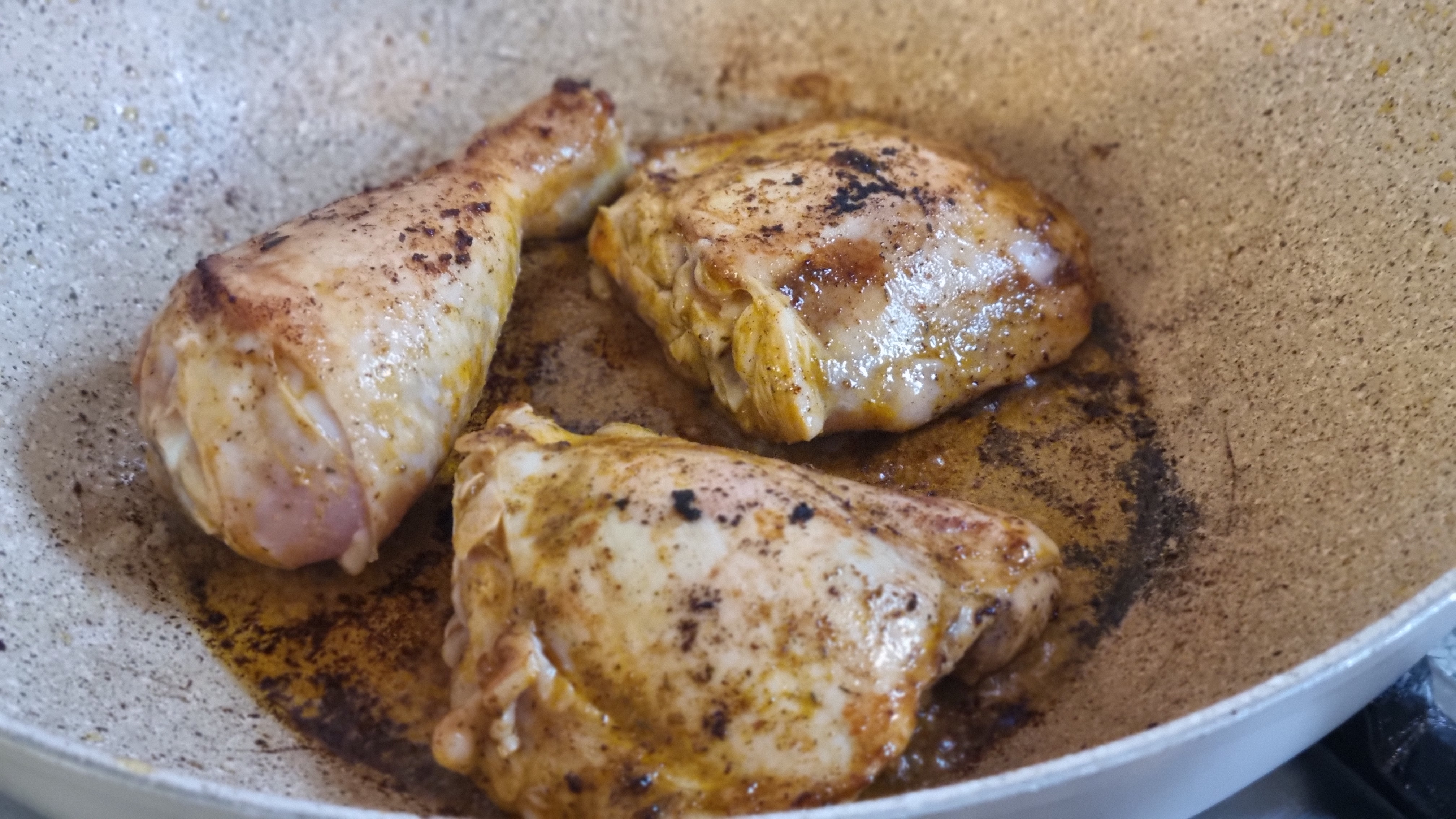
Heat olive oil in a wide, heavy pan over medium-high and brown the chicken skin-side down for about 4 minutes. You want real golden colour, not just a brief sear. Turn and brown the other side. If your pan isn’t wide enough to fit everything, work in batches. Crowding the pan drops the temperature and you end up steaming rather than browning.
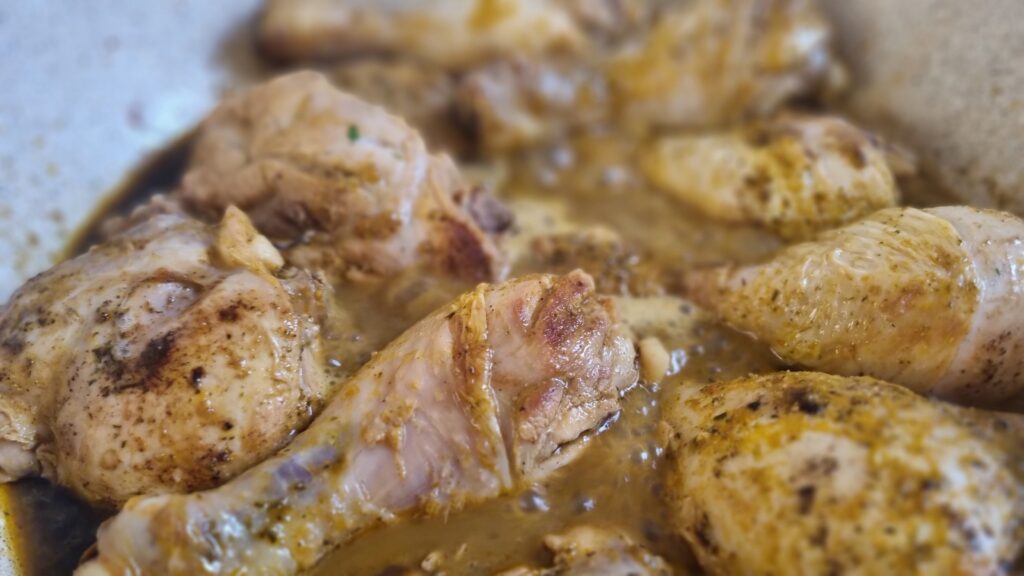
Once everything’s browned, return all the pieces to the pan and pour over the marinade. It should come roughly halfway up the chicken — add a small splash of water if it’s short. Cover and cook on a low simmer for 35–40 minutes, turning the chicken once. Keep the heat low: you want the sauce to reduce slowly, not boil off.
For the last 10 minutes, take the lid off. The sauce will thicken and deepen in colour. Taste before serving and adjust the salt — the wine and vinegar vary so it’s worth checking.
- Make the marinade. Pound garlic and salt in a mortar to a smooth paste. Add paprika, cumin, oregano and black pepper and mix. Add wine, vinegar and olive oil and stir or mix in a blender for a smoother sauce.
- Marinate. Put chicken in a bowl or bag, pour over the marinade, add bay leaves. Turn to coat. Cover and refrigerate at least 4 hours, overnight if possible.
- Before cooking. Take chicken out of the fridge 30 minutes early. Remove from the marinade, keep the liquid, pat the pieces dry.
- Brown. Heat olive oil in a wide heavy pan over medium-high. Brown skin-side down for 4 minutes until golden. Turn and brown the other side. Work in batches if needed.
- Cook in the marinade. Return all chicken to the pan. Pour over the marinade — it should reach halfway up the pieces. Cover and simmer on low for 35–40 minutes, turning once.
- Reduce and finish. Remove the lid for the final 10 minutes. The sauce will thicken and darken. Taste for salt before serving.
What to serve it with
The traditional pairing is papas arrugadas — the small Canarian potatoes boiled in heavily salted water until the skin dries and wrinkles. They’re the obvious choice: the bland, starchy potato balances the intensity of the sauce and soaks up every last drop.
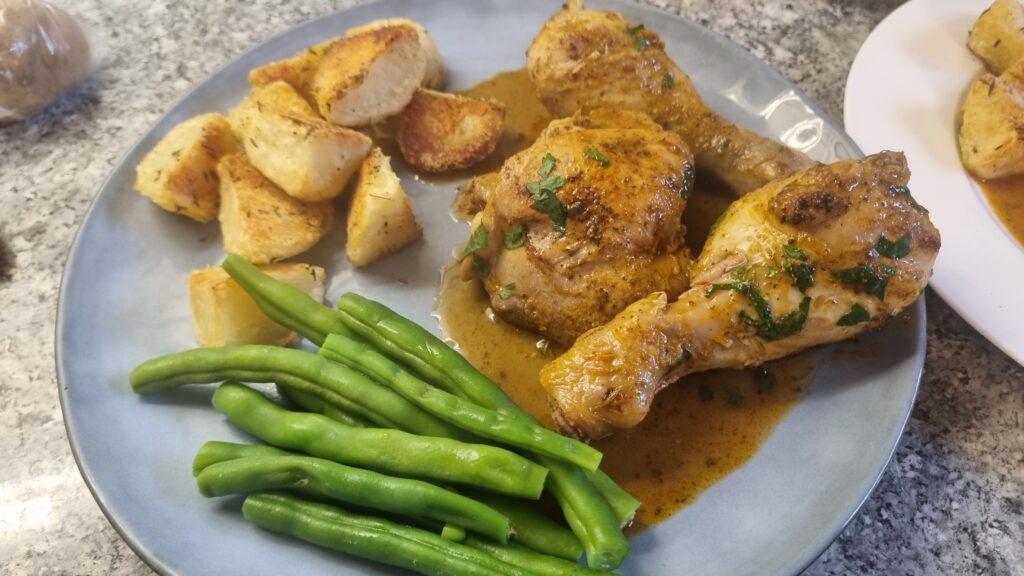
I served this with thyme-roasted potatoes and green beans. It’s not strictly traditional, but it works well — the potatoes still absorb the sauce and the green beans cut through the richness.
Don’t waste the sauce. It’s excellent for mopping with bread, and a spoonful stirred through cooked pasta or rice works well with leftovers. The sauce keeps in the fridge for 3–4 days and freezes well.
Questions
No. The Andalusian salmorejo — particularly the one from Córdoba — is a chilled thick soup made from tomatoes, bread and olive oil. The Canarian salmorejo is a wet marinade: garlic, paprika, cumin, wine and vinegar. Same word, completely different dishes. The name shares the same Arabic-derived root but the two diverged centuries ago.
Up to 24 hours is fine. Beyond that, the vinegar starts to break down the texture of the chicken — especially with thinner pieces like breast. For whole legs and thighs, 24 hours is good. Don’t push it much further.
A dry white — something light and not sweet. You don’t need to spend much, but use something you’d drink a glass of. Cheap cooking wines often have added salt and a slightly synthetic edge that carries through. A basic supermarket white at €3–5 is perfectly fine.
If you want to keep it local, Canarian whites work well here.
You can, but bone-in gives a better sauce. The bones add body and collagen to the cooking liquid, which is what makes the sauce thick rather than thin and watery. With boneless pieces, check after 25 minutes — they cook faster and dry out if left too long.
It’s definitely better made in advance. The sauce is more delicious and rich as the flavour deepens overnight. Make it the day before, refrigerate once cooled, and reheat gently with the lid on. Keeps for 3 days in the fridge and freezes well.
Yes — the marinade is identical. Rabbit (conejo) is leaner, so the sauce tends to reduce a little further. Cooking time is roughly the same. You can find rabbit pieces at local markets and most butchers in the Canary Islands.
Papas arrugadas (wrinkly potatoes) are small waxy potatoes cooked in a large amount of salt until the water evaporates and the skins dry and wrinkle. Use about 2–3 tablespoons of salt per 500g of potatoes in the water — far more than you’d expect. Boil until cooked, drain, then return to the dry hot pan for a minute to finish the skins. Served whole, eaten with the skin on. Look for small Canarian new potatoes (papas bonitas) if you can find them.
Pollo al Salmorejo Canario
Ingredients
The chicken
- 1 whole chicken, cut into quarters (pollo entero cortado en cuartos) approx. 1.2–1.5kg, or equivalent bone-in pieces
- olive oil and salt for browning
The marinade (salmorejo)
- 6 cloves garlic peeled
- 1 tsp fine salt
- 2 tsp sweet paprika (pimentón dulce)
- 1 tsp ground cumin (comino)
- 1 tsp dried oregano (orégano)
- ½ tsp freshly ground black pepper
- 200 ml dry white wine use something you would drink — quality carries through to the sauce
- 3 tbsp white wine vinegar or apple cider vinegar — both work well
- 4 tbsp olive oil
- 2 bay leaves (hojas de laurel)
Instructions
- Pound the garlic and salt in a mortar until you have a smooth paste. Add the paprika, cumin, oregano and black pepper and mix well. Add the wine, vinegar and olive oil and stir to combine.
- Put the chicken pieces in a bowl or zip-lock bag. Pour over the marinade and add the bay leaves. Turn to coat thoroughly. Cover and refrigerate for at least 4 hours — overnight gives a noticeably better result.
- Take the chicken out of the fridge 30 minutes before cooking. Remove the pieces from the marinade and keep all the liquid. Pat the chicken pieces dry.
- Heat a little olive oil in a wide, heavy pan over medium-high heat. Brown the chicken skin-side down for about 4 minutes until golden. Turn and brown the other side. Work in batches if needed — don’t crowd the pan.
- Return all the chicken to the pan and pour over the reserved marinade. It should come about halfway up the pieces — add a splash of water if it’s short. Bring to a simmer, cover and cook on low for 35–40 minutes, turning the chicken once halfway through.
- Remove the lid for the final 10 minutes to let the sauce reduce and thicken. Taste for salt before serving.
Notes
Vinegar: apple cider vinegar works just as well as white wine vinegar.
Chicken: any bone-in pieces work. Ask the butcher for “un pollo entero cortado en cuartos” for a whole chicken in quarters.
Make ahead: this dish is better the next day. Refrigerate once cooled and reheat gently.
Serving: papas arrugadas (wrinkly Canarian potatoes) are the traditional pairing. Thyme-roasted potatoes and green beans also work well.
Feeling inspired? Check out our other authentic Canarian recipes here, including this gorgeous almogrote recipe from La Gomera.