If you’ve ever seen people parading through a Tenerife town in stunning traditional costumes, riding on ox carts piled high with bread and wine, you’ve stumbled upon one of the most joyful, authentic experiences the Canary Islands has to offer. This is a romería — and this guide tells you everything you need to know, including what to wear, where to buy an outfit on any budget, and exactly how to join in without putting a foot wrong.
📌 Bookmark this guide
This guide is designed to be shared when friends ask “What is a romería?”, “What should I wear?”, or “Where can I buy an outfit?” in Facebook groups. Every question you’ve seen asked — and asked yourself — is answered here.
What is a Romería?
A romería (pronounced ro-meh-REE-ah) is a traditional pilgrimage and harvest festival that forms the beating heart of Canarian culture. The word comes from the Spanish “romero” — meaning rosemary, a plant traditionally carried by pilgrims — and these celebrations combine religious devotion, agricultural heritage, and joyful community spirit into one unforgettable event.
In practical terms, a romería involves a procession of pilgrims — on foot, on horseback, or riding in beautifully decorated ox carts — making their way to a local chapel or church to honour a patron saint. But to describe it only as a religious event would be to miss most of the magic. By the time the procession is over, the streets fill with food, wine, music, dancing, and the kind of warm community gathering that reminds you why you moved to the Canary Islands in the first place.
Romerías are not tourist events staged for visitors. They are deeply personal occasions for local families — and that is precisely what makes them so special to be part of.
A Brief History of Romerías
Romerías in the Canary Islands trace their roots to the late 17th and early 18th centuries, when farmers living in remote hamlets would make a seasonal pilgrimage to their parish church to give thanks to their patron saint for the year’s harvest. This was an act of pure faith rooted in the rhythms of agricultural life — when the land gave, you gave thanks.
Over time, these simple walks of thanksgiving evolved into something richer. Families began decorating ox carts with palm fronds, flowers, and the fruits of their harvest. Neighbours walked together, sharing food and drink along the way. Musicians joined the procession. The event became an annual reunion. It became a moment to reconnect with the land, the community, and the traditions of the islands.
The costumes that are now so central to romerías reflect the historical dress of Canarian farmers and labourers of the time. Each island developed its own distinct style, with variations in colour, embroidery, and headdress from municipality to municipality. Wearing the traje típico canario at a romería is an act of cultural pride, and municipalities such as Los Realejos run campaigns to ensure that the tradition continues and that younger generations wear the correct outfits.
Today, several Tenerife romerías have been declared Festivals of National Tourist Interest by the Spanish government — recognition of their cultural significance not just to the islands, but to Spain as a whole. Yet despite this official recognition, they remain deeply local affairs at heart, organised by communities for communities.
What Actually Happens at a Romería?
Every romería has its own character, but most share the same essential elements. Here is what to expect:
The Procession
The centrepiece of any romería is the procession itself. The statue of the local patron saint or Virgin Mary is carried from a hermitage (chapel) to the main church, accompanied by pilgrims walking, riding horses, or travelling in decorated ox carts. A priest holds a mass in honour of the saint, and the air fills with devotional songs called sevillanas rocieras.
The procession can last several hours. Some participants walk as an act of personal devotion, completing the journey barefoot or on their knees in prayer. Respect this quiet sincerity even as the celebration flows around it.
The Carretas (Ox Carts)
The decorated ox carts — carretas — are the visual soul of a romería. These heavy wooden carts are pulled by pairs of oxen wearing elaborate floral headdresses, and the carts themselves are masterpieces of folk art: adorned with palm fronds, dried grasses, garlands of flowers, woven bread, wine barrels, baskets of local produce, and agricultural tools.
Preparing a carreta takes months of work by entire families and neighbourhoods. The pride families take in their cart is immense, and admiring it is always welcome. The carts also carry the food and drink that will be shared during the celebration.
The Food and Drink
Sharing food is one of the most beautiful aspects of any romería, and visitors are frequently and generously offered a taste of everything. Do not be shy — accepting food is a sign of respect and gratitude. Here is what you’ll encounter:
- 🍞 Gofio amasado: Toasted grain flour kneaded with honey, olive oil, and almonds into a thick, dense disc. This is one of the oldest foods in Canarian history, dating back to the indigenous Guanche people. Rich, earthy, and delicious.
- Gofio pella: A sweeter version mixed with honey or ripe banana, almonds, and raisins. Often shaped into balls.
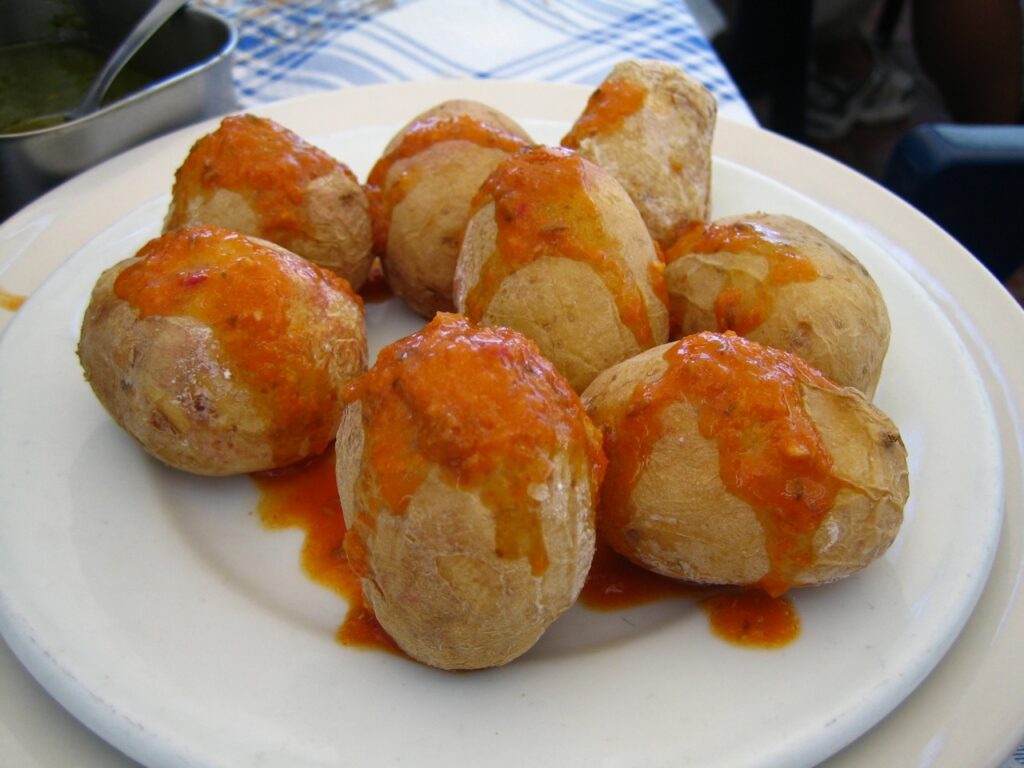
- 🥔 Papas arrugadas: Canarian wrinkled potatoes, boiled in heavily salted water until their skins crinkle. Always served with mojo — either the green herb mojo verde or the fiery red mojo rojo.
- 🧀 Local cheese: Fresh goat or sheep cheese, often served simply or with honey.
- 🍖 Goat meat: Slow-cooked goat, a traditional centrepiece of Canarian feast food.
- 🍷 Local wine: Canarian wine flows freely. The islands produce excellent wines from volcanic soils. Expect generous pours from terracotta jugs.
The Music and Dancing
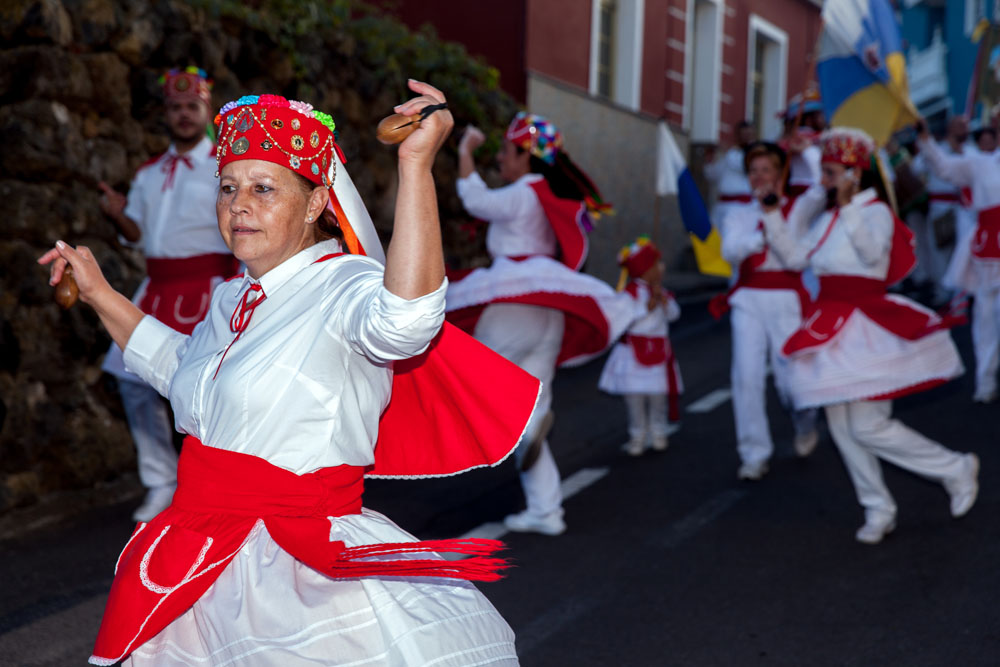
Romerías are alive with music. Folk bands play the timplé (a small Canarian stringed instrument similar to a ukulele), guitars, tambourines, and drums. The traditional dances — the isa, the folías, the malagueñas, and the seguidillas — bring pilgrims together in spontaneous circles. You do not need to know the steps to join in; an enthusiastic shuffle is warmly welcomed.
Traditional Canarian wrestling (lucha canaria) and garrote (stick fighting) displays are also common at larger romerías, giving visitors a rare glimpse of ancient sporting traditions.
The Atmosphere
Imagine a warm afternoon, the smell of grilled meat and wood smoke in the air, the sound of guitars and laughter drifting through cobblestone streets, families three generations deep gathered around tables of food, children in miniature traditional costumes running between the ox carts — and everyone somehow managing to make strangers feel immediately at home. That is a Tenerife romería.
Part religious ceremony, part harvest thanksgiving, part neighbourhood reunion, and part outdoor festival — a romería is unlike any other event. Even if you don’t speak Spanish, you’ll feel the warmth immediately.
The 2026 Romerías Calendar for Tenerife
Tenerife’s romería season runs from January through October, with the most spectacular events concentrated between April and August. Highlighted rows below mark the biggest celebrations of the year.
| Date | Romería / Event | Location | Notes |
|---|---|---|---|
| 17 Jan | Romería de San Antonio Abad | Multiple municipalities | Opens the romería season. Celebrated in Arona, Los Realejos, Buenavista del Norte, La Orotava, Güímar and more. |
| 21 Mar | Romería de San José | Barranco Hondo, Candelaria | Early-season local romería. |
| 19 Apr | Baile de Magos Infantil | Tegueste | Children’s traditional dance event — excellent for families. |
| 25 Apr | Paseo de las Tradiciones / Baile de Magos | Icod de los Vinos | Traditional dance parade through one of Tenerife’s most historic towns. |
| 26 Apr | ★ Romería de San Marcos | Tegueste | One of the oldest and most beloved romerías in Tenerife. Authentic, intimate community feel. |
| ~17 May | Romería de San Isidro | Los Realejos | 3rd Sunday of May. Dedicated to San Isidro, patron saint of farmers. |
| May | Romería de San Isidro | Guía de Isora | South-west Tenerife. Confirm exact date with the local ayuntamiento. |
| 14 Jun | ★★ Romería de San Isidro Labrador y Santa María de la Cabeza | La Orotava | One of the most spectacular romerías in the islands. Set against the backdrop of the UNESCO-listed town of La Orotava. |
| 20 Jun | Romería de San Antonio de Padua | Granadilla de Abona | South Tenerife. Growing in popularity. |
| 12 Jul | ★★ Romería Regional de San Benito Abad | La Laguna (San Cristóbal de La Laguna) | THE BIGGEST IN TENERIFE. Festival of National Tourist Interest. All 7 Canary Islands represented. Unmissable. |
| Jul | Bajada del Poleo | Icod de los Vinos | Traditional celebration in the historic north-coast town. |
| 1 Aug | Subida El Amparo | Icod de los Vinos | Local romería. |
| 14–15 Aug | ★★ Romería / Bajada de Candelaria | Candelaria | Over 150,000 pilgrims walkfrom a cross the island to the Basílica de Candelaria. Extraordinary to witness. |
| 15 Aug | Romería de Arico | Arico (El Río) | South-east Tenerife. Traditional farming-community feel. |
| 16 Aug | ★★ Romería de San Roque | Garachico | Festival of National Tourist Interest. The saint is taken out to sea by fishing boats — unlike any other romería in the islands. |
| 29 Aug | Romería de San Agustín | Arafo | Inland Tenerife. Authentic, less-touristed. Insider’s favourite. |
| Aug–Sep | Romería de El Socorro | Güímar | Popular east-coast romería. Confirm exact date locally. |
| 2 Oct | Romería de El Toscal | Santa Cruz de Tenerife | City romería bringing the tradition into the capital. |
📅 How to find exact dates
Many romerías are confirmed by their town hall (ayuntamiento) a few weeks before the event. Always check the local ayuntamiento website or their Facebook page before travelling.
Local Facebook groups for expats in Tenerife (including ours: Canary Islands Expats) are also an excellent real-time source. Look for banners and posters in town squares and outside local churches.
★ = Major romería | ★★ = Festival of National Tourist Interest / absolutely unmissable
The Six Romerías You Should Not Miss
If you can only make it to a handful, these are the ones that will stay with you:
1. Romería Regional de San Benito Abad — La Laguna | 12 July 2026
This is the biggest romería in Tenerife, and arguably the most spectacular in the entire Canary Islands. Declared a Festival of National Tourist Interest, the Romería de San Benito Abad in the UNESCO-listed city of La Laguna draws hundreds of thousands of spectators and participants.
What makes it exceptional is its regional scope: groups representing all seven Canary Islands participate, each with their own distinct traditional costumes, music, and decorated carretas. It is, in effect, a living museum of Canarian culture moving through the streets of La Laguna.
Arrive early to secure a good viewing spot, and spend the whole day — this is an all-day affair. The old city of La Laguna is beautiful to explore before and after the procession.
2. Romería de San Isidro Labrador — La Orotava | 14 June 2026
La Orotava’s romería is famous throughout Spain, and for good reason. The town is extraordinarily beautiful — colonial mansions, cobbled streets, and the extraordinary floral and volcanic sand carpets laid for Corpus Christi provide a stunning backdrop.
The romería honours San Isidro, the patron saint of farmers, and the parade of carretas through the town is one of the most photographed in the islands. La Orotava has a particular richness to its romería tradition that draws visitors rom a cross Tenerife every year.
3. Romería de San Marcos — Tegueste | 26 April 2026
Tegueste’s San Marcos romería is one of the oldest in Tenerife and holds a special place in the hearts of many Tinerfeños. This small, proud agricultural town throws itself entirely into the celebration. The baile de magos (traditional dance gathering) that accompanies it is among the most authentic you’ll find anywhere.
This romería has a particular intimacy that larger events can’t replicate. An excellent choice for those who want a genuine, community-scale romería without the crowds.
4. Romería de San Roque — Garachico | 16 August 2026
Garachico’s romería is unlike any other in the islands. San Roque’s statue is transported out to sea on a fishing boat, accompanied by a flotilla of decorated vessels, before returning to shore in a maritime procession. This fusion of land-based romería tradition with the town’s deep fishing heritage makes for an extraordinarily moving spectacle.
The image of the saint going out to sea at sunset is one of the most memorable in Tenerife’s cultural calendar. Also a Festival of National Tourist Interest. The beautiful historic harbour town itself is worth a visit at any time of year.
5. Romería / Bajada de Candelaria | 14–15 August 2026
The pilgrimage to Candelaria is the single largest act of religious devotion in the Canary Islands. Over 150,000 people walkfto the Basílica de Candelaria over the night of 14–15 August to honour the Virgen de Candelaria, patron saint of the islands.
Even if you do not walkfthe route yourself, witnessing the streams of pilgrims arriving at the basílica in the early hours is deeply moving. This is Canarian faith at its most raw and sincere.
6. Romería de San Agustín — Arafo | 29 August 2026
Arafo’s romería is the insider’s choice — a genuine, working-community romería in a village that hasn’t been discovered by the tourist circuit. Inland rom aGüímar on the slopes of Teide’s south face, Arafo is farming country, and its romería reflects that agricultural soul completely. Come here for the real thing, with none of the crowds.
What to Wear: The Traditional Canarian Costume
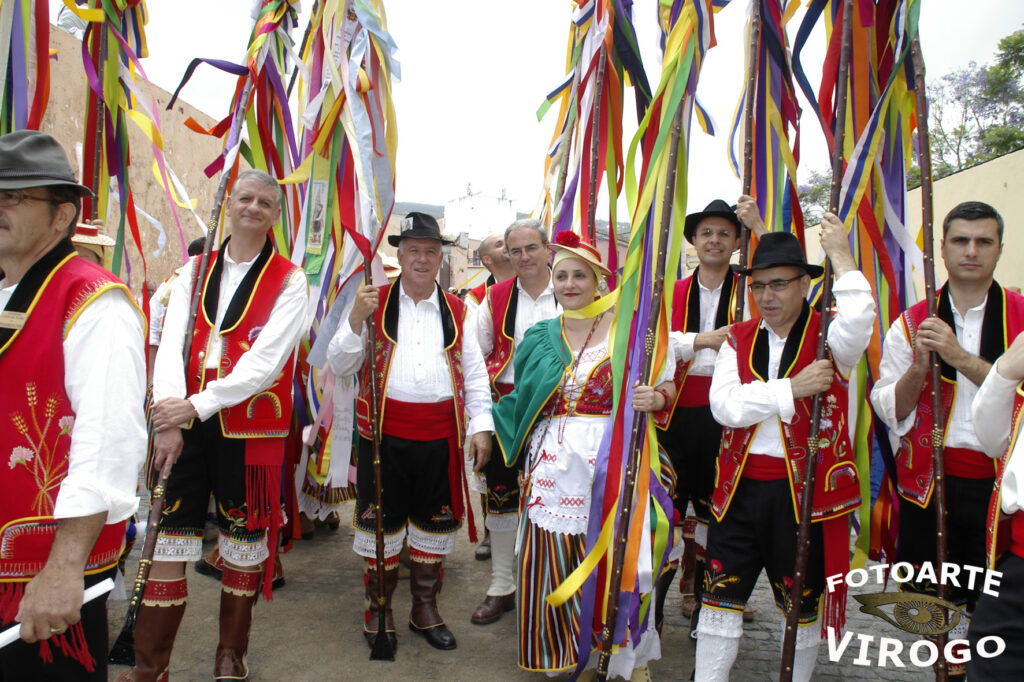
The traje típico canario is the most visible symbol of a romería. These are not fancy-dress costumes; they are genuine traditional garments with centuries of history behind them, representing the clothing of Canarian farmers and agricultural workers.
Each island has its own distinct costume, and within Tenerife, different municipalities have their own variations in colour, embroidery style, and headpiece. The overview below covers the Tenerife style that you’ll see at most local romerías.
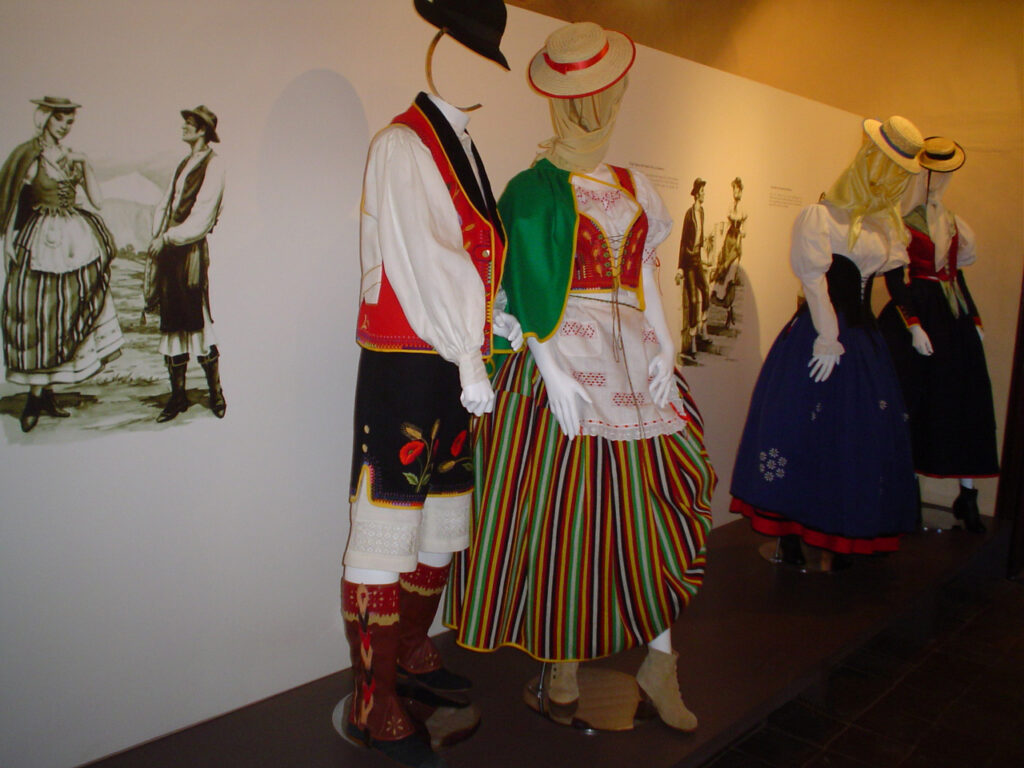
Women’s Costume
- Skirt (falda): A long, below-the-knee or ankle-length woollen skirt, traditionally woven on a loom, with a red or black base and coloured longitudinal stripes. The skirt should be full and flowing.
- Petticoat: A taped and embroidered petticoat worn underneath to give the skirt its shape. Often as decorative as the skirt itself.
- Apron (delantal): An embroidered apron worn over the skirt — one of the most decorative elements of the costume, often with intricate needlework in contrasting colours.
- Blouse (blusa): A white blouse with an embroidered or lace-trimmed bodice. The embroidery typically matches the apron.
- Headpiece: Varies by municipality — a small decorated hat, a hair net, ribbons, or flowers. Ask in the costume shop what is traditional for the specific romería you’re attending.
- Basket (cesto): Woven baskets filled with bread, fruit, or flowers are carried by women in the procession. A lovely addition to any costume — and doubles as a practical carry-all.
- Shoes: Traditional esparto-soled shoes (alpargatas) or simple flat shoes. Comfortable is essential — you may be walking for several hours.
- Hair: Typically worn up, with traditional pins, combs, or ribbons. A low bun or braided updo suits the costume well.
Men’s Costume
- Trousers: Black woollen trousers, above the ankle — traditionally quite fitted. Some municipalities use a wider-cut trouser.
- Shirt: A white shirt or blouse, often with simple embroidery on the cuffs or collar. Linen or cotton.
- Waistcoat/vest: A black waistcoat worn over the shirt — essential to the overall look.
- Sash (faja): A red sash tied at the waist. The most visually striking element of the men’s costume and immediately identifiable as Canarian.
- Hat: A traditional wide-brimmed hat — typically straw or dark wool depending on the region and season.
- Leggings: Embroidered linen leggings covering the lower leg, worn over the trouser hem. Specific to the Tenerife style.
- Shoes: Dark simple shoes or boots. Prioritise comfort.
Do You Have to Dress Up?
No — there is no requirement for visitors or expats to wear a traditional costume. However, locals absolutely love and appreciate it when outsiders make the effort. Even a partial costume is warmly received: a traditional skirt with a modern top, a red sash tied around jeans, or a decorated hat will be met with smiles and, very often, invitations to join in more fully.
Children in traditional costumes are especially adored. Dressing your kids up is one of the fastest routes to being welcomed into the community spirit of the day.
If you choose to wear the full costume, please do it respectfully. This is real cultural heritage, not a fancy dress theme. Buy from reputable suppliers, keep the outfit neat and appropriate, and wear it with genuine pride.
👗 Practical costume tips
Summer romerías can be extremely hot. Choose breathable fabrics where possible, and wear sunscreen.
Long skirts can drag on cobblestones in crowds — pin the hem slightly, or choose ankle-length rather than floor-length.
Flat shoes only. The cobblestones of old Tenerife towns are beautiful but uneven.
Book or buy your costume well in advance of the big romerías. Stock at El 99 and other shops sells out in the weeks before San Benito and San Isidro.
Where to Buy Your Romería Outfit in Tenerife
One of the most common questions in expat Facebook groups — especially from newer arrivals — is where to find a romería outfit. The answer depends on your budget and how authentic you want to go.
El 99 (Confecciones El 99) — Best Budget Option
El 99 is the go-to for most residents who want a decent-quality, affordable traditional outfit. They stock a wide range of trajes típicos canarios, rom acomplete outfits to individual pieces (skirts, aprons, blouses, sashes, baskets). Quality is functional and presentable — you will look the part. Website: el99.es
| Location | Address | Notes |
|---|---|---|
| Santa Cruz de Tenerife | Rambla de Pulido, 42 | City centre; easy to reach by tram |
| La Laguna | Av. de los Menceyes, 433, Edificio Tindaya | Near the university and bus station |
| La Orotava | C. Alfonso Trujillo, 9 | Ideal before the San Isidro romería |
| Puerto de la Cruz | Av. Molinos de Gofio, 2, Local B-17, CC El Trompo | North Tenerife |
| Los Cristianos | Av. Juan Carlos I, Local B-7-14, Edificio Royal | Serves the south of the island |
Chinatown Stores — Good Value Accessories and Individual Pieces
Tenerife’s Chinese-owned clothing stores (often called “Chinatown”) are a good source of affordable individual costume pieces — sashes, headpieces, fake flower decorations, espadrilles, and some skirts and blouses. There are stores around the islands, including large ones in El Trompo shopping centre in the north, in Los Majuelos, Los Realejos Alto, and Los Rodeos close to the north airport.
- Chinatown Las Chafiras in the south: they always have a lot of romeria clothing options during the season.
- Los Rodeos (near Tenerife Norte airport): Chinatown Los Rodeos.
Note: Chinatown stores are better for accessories and supplementing an outfit than for a complete high-quality costume. For the best value complete outfit, El 99 is the more reliable choice.
Authentic and High-End Options — For Those Who Want the Real Thing
If you want a genuinely beautiful, traditional costume (always a nice idea if you are a long-term expat here), these specialist shops are where to look:
Los Calados Artesanía — La Laguna
Located at C/ Alcalde Alonso Suárez Melián, 24, La Laguna (behind the Teatro Leal). Los Calados offers an exceptional range of traditional costumes rom adifferent regions of Tenerife and across the Canary Islands. The quality of the embroidery and craftsmanship is several levels above the budget options, and the staff are knowledgeable about regional variations. They also have a shoemaker’s workshop in the basement for traditional footwear. Website: loscalados.es.
El Botón — San Isidro
A specialist in Canarian traditional costumes and Ibizan fashion. Worth visiting if you’re in the south of the island and want something more authentic than the chain stores. Find it on Google Maps.
Artesanía Islas Canarias
Traditional Tenerife costumes available to buy — and some options for rental, which is ideal if you only plan to attend one or two romerías. Worth enquiring about rental availability. Find it on Google Maps.
Online Option
- TrajeRegional.com: Comprehensive online catalogue with good prices. Based in the mainland, so allow at least two weeks for delivery.
Price Guide
| Item | Price Range | Notes |
|---|---|---|
| Individual accessories (sash, headpiece, basket) | €5 – €20 | Chinatown areas, El 99 |
| Complete outfit – El 99 / budget | €60 – €120 | Functional & presentable — good for most romerías |
| Complete outfit – mid-range artesanía | €120 – €250 | Better fabric, quality embroidery |
| Full handcrafted traditional outfit | €250 – €500+ | Heirloom quality — Los Calados & specialist makers |
| Costume rental (per day) | €15 – €40 | Some artesanía shops; enquire in advance |
The Respectful Visitor’s Guide
Romerías are welcoming by nature; locals genuinely enjoy seeing visitors participate. But as with any event rooted in genuine religious faith and cultural tradition, a little awareness goes a long way to avoid causing offence.
✅ Do These Things
- Dress the part (or try to): Even a partial costume signals effort and respect. You’ll be welcomed far more warmly.
- Accept food and drink when offered: This is an act of hospitality and community. Refusing can seem rude. If you don’t drink alcohol, just accept the glass and hold it, there’s no pressure to drink.
- Greet people warmly. A simple “¡Hola!” and a smile opens many doors. Even basic Spanish is enormously appreciated.
- Show respect during the procession: Stand to the sides, keep noise low when the statue passes, and be mindful that this is a religious moment for many people, not just a parade.
- Stay for the dancing! The party after the procession is where you’ll make friends. Join a circle of folk dancers, even if you’re just clapping along. It’s almost impossible to be unwelcome at a Canarian dance.
- Ask before photographing people: “¿Puedo hacerte una foto?” means “May I take your photo?” Many locals are delighted to pose in their costumes, but always ask first, particularly during any religious ceremony.
- Stay hydrated: very important! Summer romerías in Tenerife can be extremely hot. Bring water and wear sunscreen.
❌ Avoid These Things
- Treating it as a tourist photo opportunity only. Romerías are real community events. Wandering through with a camera without engaging is noticeable and can feel disrespectful. Participate, even a little.
- Wearing costume ironically or as a joke. The traje típico is cultural heritage. Wear it sincerely, or not at all.
- Being noisy during mass or the procession. The religious portions of the event deserve genuine respect. Keep phones on silent and lower your voice.
- Arriving and leaving quickly. Romerías definitely reward patience. If you’re only there for twenty minutes, you’ll miss the heart of it.
- Beachwear or holiday clothing: Even if you don’t wear traditional dress, neat clothing shows respect. Beachwear is not appropriate.
- Blocking the procession route: Stand to the sides, keep children safely away from the oxen and carts, and leave the route clear for participants.
A Note on Religion
It is easy to focus on the festive aspects of a romería and forget that it begins as an act of religious devotion. Many participants are walking as a personal spiritual commitment; some barefoot, some in prayer. This faith is genuine and deep, and it deserves the same respect you would give in a church.
You don’t need to be Catholic, Christian, or religious in any way to attend and enjoy a romería. But an awareness of the spiritual significance of what you’re witnessing will enrich your own experience and ensure you’re a welcome presence.
Romerías Beyond Tenerife: The Other Canary Islands
Every island in the archipelago has its own romería tradition. Here are the notable ones to know if you live on or travel to other islands:
🇬🇨 Gran Canaria
Gran Canaria has a rich romería calendar, with festivals in virtually every municipality. Key events for 2026:
- Romería de San Marcos — Agaete (April): One of the most beautiful north-coast celebrations.
- Bajada de La Rama — Agaete (4 August): An ancient pre-Hispanic ceremony in which branches are swept into the sea to call for rain. Unlike any other festival in the islands.
- Romería de la Virgen de las Nieves — Agaete (8 August): Held in the same pretty town as San Marcos, with a very different character.
- Romería de la Virgen del Pino — Teror (September): Dedicated to the patron saint of Gran Canaria — a major island-wide event.
- Mogán — Honour of San Antonio “El Chico”: One of the most traditional festivals in Gran Canaria. Traditional costume is required to participate in the procession.
🇫🇻 Fuerteventura
- Romería de la Virgen de la Peña (10 September): Dedicated to the patron saint of Fuerteventura, held at the pilgrimage chapel of Vega de Río Palmas. Pilgrims converge on this remote spot in a deeply moving display of island-wide devotion.
🇱🇨 Lanzarote
- Romería de Los Dolores — Tinajo (13 September): Dedicated to the patron saint of Lanzarote. The tradition dates directly to the catastrophic volcanic eruptions of 1730–1736, when desperate communities prayed to the Virgin for protection. This origin gives the romería a particular emotional depth.
La Palma
La Palma is famous above all for the Bajada de la Virgen, an extraordinary festival held every five years (next edition: 2030) in which the Virgin’s statue descends rom aits mountain sanctuary to the capital in a week-long celebration of extraordinary beauty. In between Bajada years, the island has numerous local romerías across its municipalities.
El Hierro
Bajada de la Virgen de los Reyes (every four years): One of the most remote and authentic pilgrimages in the Canary Islands. The route covers 43 kilometres, accompanied by the haunting tambor de El Hierro — a 12-kilogram drum unique to the island — along with chácaras and the pito herreño.
Frequently Asked Questions
These are the questions that appear most often in expat Facebook groups. Share this section directly when someone asks!
What is a romería?
A romería is a traditional Canarian pilgrimage and harvest festival honouring a local patron saint. It combines a religious procession with decorated ox carts, pilgrims in traditional costume, and devotional singing, with a joyful community celebration of music, dancing, and shared traditional food and wine.
Do I have to wear a costume to attend a romería?
No, but locals love it when visitors make the effort. Even a partial costume (a traditional skirt, a red sash, or a headpiece) is warmly received. If you don’t dress up, wear neat modest clothing rather than beachwear.
Where is the cheapest place to buy a romería outfit in Tenerife?
El 99 (Confecciones El 99) is the go-to budget option, with branches in Santa Cruz, La Laguna, La Orotava, Puerto de la Cruz, Los Realejos and Los Cristianos. Chinatown stores (particularly Los Majuelos near La Laguna and Los Rodeos near Tenerife Norte airport) are good for accessories and individual pieces.
Where can I get a more authentic or high-end costume?
Los Calados Artesanía in La Laguna (C/ Alcalde Alonso Suárez Melián, 24) is the most recommended specialist for quality traditional costumes. El Botón in San Isidro is another good option. Online, try eltipicodetenerifeshop.com or trajeregional.com.
What is the biggest romería in Tenerife?
The Romería Regional de San Benito Abad in La Laguna, held on or around 12 July, is the largest in Tenerife. It’s a Festival of National Tourist Interest and brings representatives rom a ll seven Canary Islands. Hundreds of thousands attend.
Can tourists and expats join in a romería?
Absolutely yes. Romerías are inclusive and welcoming community events. Visitors who make genuine effort to participate — wearing costume, accepting food and drink, staying for the dancing — are always warmly received. Just be respectful during the religious portions of the event.
What food will there be at a romería?
Expect gofio amasado (kneaded toasted grain flour with honey and almonds), papas arrugadas with mojo, local cheese, slow-cooked goat meat, and plenty of Canarian wine. Food is typically shared freely by participants — accept gratefully and you’ll have one of the best meals of your time in Tenerife.
What is gofio and how do I eat it at a romería?
Gofio is toasted grain flour — one of the oldest foods in the Canary Islands, dating back to the Guanche people. At romerías, you’ll encounter it as gofio amasado: kneaded into a thick disc with honey, olive oil, and almonds. It’s dense, earthy, and slightly sweet. Break off a piece and eat with your fingers.
What are carretas?
Carretas are the decorated ox carts that are the visual centrepiece of any romería. Pulled by pairs of oxen (who also wear elaborate floral headdresses), the carts are piled high with agricultural produce, bread, wine, and rlowers. Families spend months preparing their carreta. Admiring the craftsmanship is absolutely encouraged.
Is it rude to take photos at a romería?
Photos are generally fine, but always ask permission before photographing individuals — especially during religious moments. “¿Puedo hacerte una foto?” means “May I take your photo?” During the procession and mass, keep your phone down and be present. During the festive portion, people are often delighted to pose in their costumes.
When is the next romería near me in Tenerife?
Check the calendar table in this guide. The season runs January through October, with the big events concentrated April–August. Always verify specific dates with the local ayuntamiento (town hall) as they can shift slightly each year.
What should I NOT do at a romería?
Avoid: wearing costume ironically; being noisy during the procession or mass; arriving for 20 minutes and leaving; wearing beachwear; blocking the route; or treating it purely as a photo opportunity. These events are real community occasions — engage genuinely, and you’ll be made very welcome.
🌿 One final thought
Romerías are not put on for tourists. They are real. The faith is real, the community is real, the pride is real. When you attend one, especially dressed in traditional costume, accepting gofio from a stranger’s carreta, dancing with people whose families have done this for generations, you are not observing Canarian culture from the outside. You are briefly, warmly, part of it.
That is the gift of a romería. Don’t miss it!
— ExpatHelper.es: Your guide to life in the Canary Islands