
If you’ve moved to the Canary Islands (or anywhere in Spain) from the UK, swapping your driving licence is one of those things you know you need to do… but somehow keep putting off. I get it — the thought of navigating Spanish bureaucracy in a language you’re still learning is enough to make anyone procrastinate.
But here’s the thing: if you’ve been a resident for more than six months and you’re still driving on your UK licence, you’re technically driving illegally — and uninsured. That’s a fine of up to €500, possible car impounding, and if you’re in an accident, your insurance won’t pay out.
The good news? Thanks to the UK–Spain bilateral agreement signed in March 2023, you can exchange your UK licence for a Spanish one without taking any tests (no theory, no practical). You just need to deal with some paperwork and a very easy medical check.
Here’s everything you need to know — step by step.
The UK–Spain Driving Licence Agreement: Quick Background
After Brexit, UK licence holders in Spain were left in limbo for nearly two years. You couldn’t exchange your licence because there was no bilateral agreement between the two countries, and your UK licence was only valid for the first six months of residency.
The Spanish government finally approved the reciprocal recognition agreement on 16 March 2023, allowing UK (DVLA), Northern Ireland (DVA), and Gibraltar licence holders to exchange directly — no test required.
This agreement is still fully in effect in 2026.
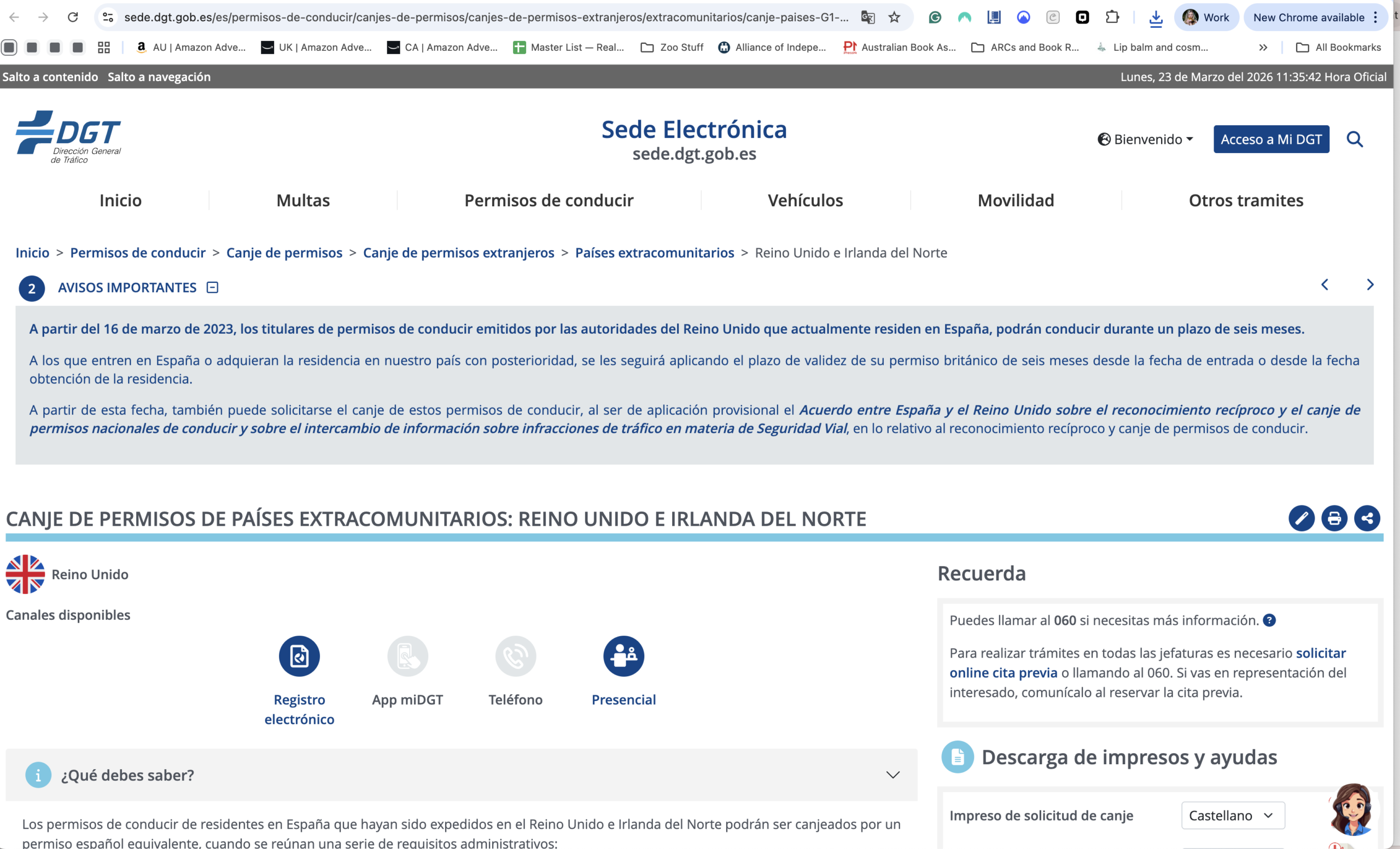
Am I Eligible to Exchange?
You can exchange your UK driving licence if:
- You hold a valid licence issued by the DVLA (England, Scotland, Wales), DVA (Northern Ireland), or Gibraltar
- You are a legal resident in Spain (you have a TIE card or green EU residency certificate)
- Your licence was issued before you became a Spanish resident (if you renewed your UK licence after becoming a resident in Spain, it may not be eligible — see the common pitfalls section below)
Important: You can still exchange an expired UK licence, as long as it was valid when you first entered Spain. However, you cannot drive on an expired licence while waiting for the exchange to go through.
Who Is NOT Eligible?
- Licences from Crown Dependencies (Jersey, Guernsey, Isle of Man) — you’ll need to take the Spanish driving test
- Licences originally issued by a non-EU country and later exchanged for a UK one — Spain reserves the right to refuse these
- Licences renewed or first issued after you became a Spanish resident
What Licence Categories Can I Exchange?
You can exchange the following categories without any test:
- AM — Mopeds (up to 50cc)
- A1 — Motorcycles up to 125cc / 11kW
- A2 — Motorcycles up to 35kW
- A — Unrestricted motorcycles
- B — Cars
- BE — Cars with trailers
For categories C (lorries) and D (buses), you’ll need an additional medical examination (Group II) and possibly further checks, but still no practical or theory test.
Your new Spanish licence will include all the categories from your UK licence, as long as your medical exam covers them.
The 6-Month Deadline: Don’t Miss It
If you became a Spanish resident after 16 March 2023, you have six months from your residency start date to exchange your licence.
During those six months, you can legally drive in Spain on your UK licence. After six months, it becomes invalid for driving in Spain — even though you can still exchange it for a Spanish one.
If you’ve already missed the deadline: don’t panic. You can still do the exchange, but you must not drive until you have at least a provisional Spanish permit in hand.
What Documents Do I Need?
Here’s the full checklist. Get all of these together before booking your appointment:
- Valid passport — original + photocopy of the photo page
- TIE card or green EU residency certificate — original + photocopy of both sides (must be in date)
- Original UK driving licence — this will be surrendered to the DGT and sent back to the DVLA. You won’t get it back.
- Padrón certificate (certificado de empadronamiento) — must be less than 90 days old. Get this from your local ayuntamiento.
- Medical fitness certificate (certificado de aptitud psicofísica) — from an authorised Centro de Reconocimiento de Conductores. Valid for 90 days. More on this below.
- One passport-style photo — 32mm × 26mm (slightly smaller than a standard passport photo — the medical centre usually takes this for you)
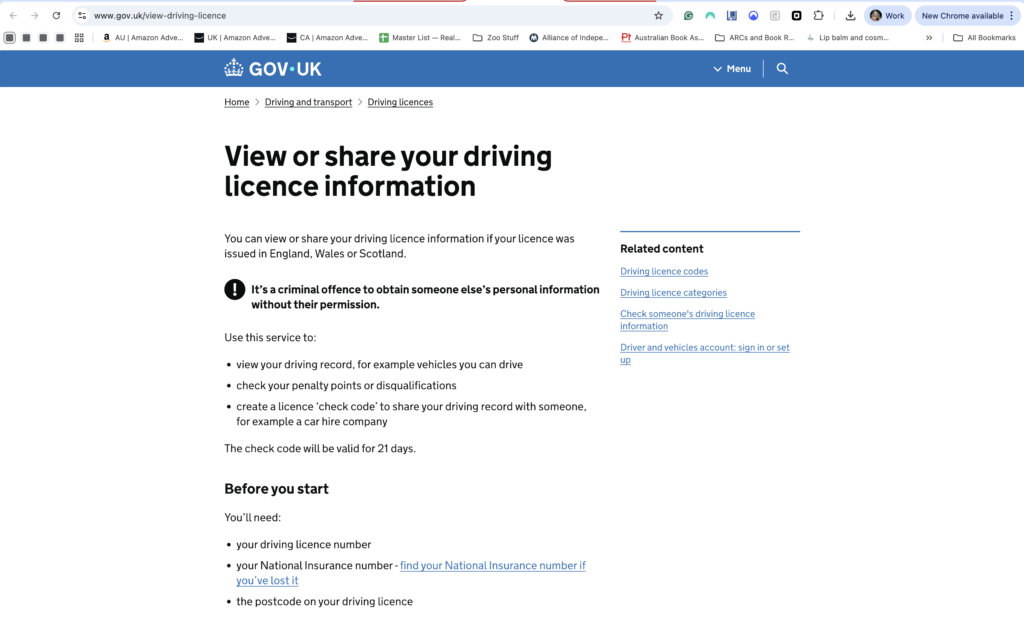
- DVLA check code — generate this online at gov.uk/view-driving-licence using your driving licence number and National Insurance number. It’s valid for about 21 days, so don’t generate it too early.
- DGT fee payment — Tasa 2.3: currently €28.87 for a standard exchange. You can pay online or at the DGT office. If additional tests are required (e.g., for C/D categories), the fee is Tasa 2.1: €94.05.
- Completed application form — the DGT office or your gestor will provide this, or you can download it from the DGT website
Pro tip: Double-check every expiry date before your appointment. The most common reason for rejection is an out-of-date padrón or medical certificate.
The Medical Test (Psicotécnico): What Actually Happens
This is the part everyone worries about — but honestly, it’s a breeze. The reconocimiento médico or psicotécnico takes about 20–30 minutes and is nothing like a UK medical.
Here’s what to expect:
Eye test — You’ll read letters from a chart, similar to an optician’s test. If you wear glasses or contact lenses, wear them. They’ll note this on your certificate.
Hearing test — Usually just a quick check. They might use a tuning fork or ask you to respond to sounds through headphones.
Reflexes and coordination — This is the fun bit. You’ll typically use a machine with two handles or a screen-based test where you have to react to moving objects (like keeping a dot on a track, or pressing buttons when lights appear). It tests your reaction time and hand-eye coordination. Don’t worry — it’s not difficult.
General health check — Blood pressure, basic questions about your medical history, any medications you take.
The photo — Most centres will take your photo (32×26mm) as part of the process.
The cost is typically €30–50 depending on the centre. The results are uploaded directly to the DGT system, so you don’t need to carry a paper certificate to your appointment (though it’s wise to keep a copy).
You’ll find Centros de Reconocimiento de Conductores in every town — just search “psicotécnico” or “reconocimiento médico conductores” on Google Maps near you. No appointment is usually needed; you can often walk in.
How to Book Your DGT Appointment (Cita Previa)
You have two options:
Option 1: Do It Yourself at the DGT
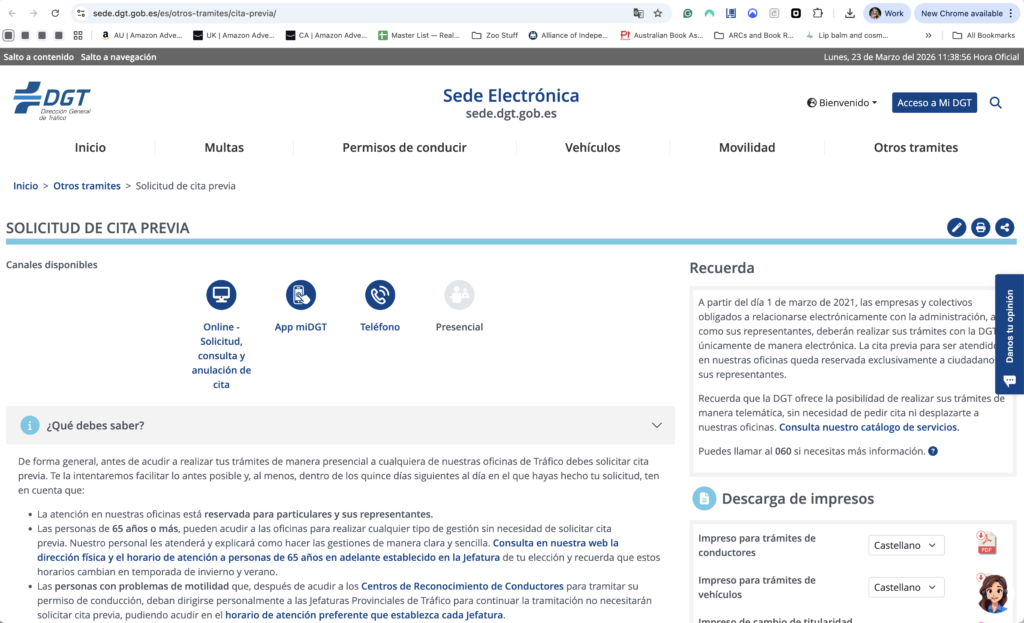
- Go to the DGT appointment booking page: sede.dgt.gob.es — Cita Previa
- Select your province (e.g., Santa Cruz de Tenerife or Las Palmas)
- Choose “Canjes” (exchanges) as the procedure type
- Pick an available date and time
- Bring ALL your documents on the day
Expect to wait 2–3 weeks for available slots in popular areas. In busy expat zones, slots can fill up fast.
From late 2025, many provinces now also offer a fully digital application process through the DGT’s electronic headquarters, where you can upload documents online. You’ll need a digital certificate or cl@ve to use this. Check sede.dgt.gob.es for your province’s options.
Option 2: Use a Gestor
A gestor (licensed administrative agent) can handle the entire process for you. They submit applications directly, often bypassing the public appointment queue. This is especially useful if:
- You can’t get a DGT appointment for weeks
- Your Spanish isn’t strong enough for the bureaucracy
- You just want someone else to deal with it
Cost: typically €100–200 on top of the DGT fees. Worth it for the peace of mind, in my opinion. Especially if you don’t speak Spanish.
DGT Offices in the Canary Islands
Here are the traffic offices (Jefaturas Provinciales de Tráfico) where you can do the exchange in person:
Tenerife
Jefatura Provincial de Tráfico — Santa Cruz de Tenerife
Calle Heliodoro Rodríguez López, 34 bajo
38071 Santa Cruz de Tenerife
Hours: Mon–Thu 8:30–15:00, Fri 8:30–14:00
Gran Canaria
Jefatura Provincial de Tráfico — Las Palmas
Plaza de los Derechos Humanos, 2
35071 Las Palmas de Gran Canaria
Hours: Mon–Wed & Fri 8:30–14:30, Thu 8:30–14:30 & 15:30–17:30
Lanzarote
Oficina de Tráfico — Arrecife
Carretera de Mármoles, 5
35500 Arrecife
Hours: Mon–Fri 9:00–14:00
Fuerteventura
Contact the Las Palmas provincial office or check the DGT website for the nearest service point. Some procedures can be handled remotely via the digital system.
La Palma
Oficina de Tráfico — Santa Cruz de La Palma
Calle Los Indianos, 22
38700 Santa Cruz de La Palma
Hours: Mon–Fri 9:00–14:00
Tip for Canary Islands residents: If you live on a smaller island (La Gomera, El Hierro), you may need to travel to the Tenerife or Las Palmas office, or use a gestor who can handle it remotely.
What Happens on the Day
- Arrive at the DGT office with ALL your documents (originals + photocopies)
- Hand in your UK driving licence — you will not get it back. It gets sent to the DVLA.
- Pay the DGT fee (€28.87) if you haven’t already paid online
- Receive a provisional Spanish driving permit — a paper document that lets you drive immediately in Spain while you wait for the plastic card
The provisional permit is valid for three months and is only valid within Spain (not for driving abroad or renting cars internationally).
Your plastic Spanish driving licence will arrive by post within 4–8 weeks, though it can take longer during busy periods. Some people report waiting 2–3 months.
After the Exchange: What You Need to Know
Your UK licence is gone. The DGT sends it back to the DVLA and it’s cancelled. If you need to drive in the UK, you can either apply for a new UK licence (you’re entitled to one as a UK citizen) or drive on your Spanish licence, which is valid in the UK for short visits.
Notify your car insurance company. Update your policy with your new Spanish licence number. Some insurers require this for continued validity.
Licence renewal. Spanish licences for categories A and B are valid for 10 years (or 5 years if you’re over 65). You’ll renew at a DGT office with another medical test — much simpler than the initial exchange.
Points system. Spain uses a points-based system (you start with 12 points, lose them for infractions). As of 2025, traffic infractions are shared between Spain and the UK, so fines and points can be enforced across both countries.
Driving in the UK. Your Spanish licence is valid for driving in the UK. You don’t need an International Driving Permit for short visits.
Common Pitfalls and How to Avoid Them
Out-of-date documents — The padrón must be less than 90 days old. The medical certificate must be less than 90 days old. The DVLA check code expires after about 21 days. Get the timing right.
Licence renewed after becoming a resident — If your UK licence was renewed or reissued after you became a Spanish resident, the DGT may refuse the exchange. This catches people who let their UK licence expire and renewed it from Spain.
Missing photocopies — Bring photocopies of EVERYTHING. Originals plus copies of both sides where applicable (especially the TIE card). The DGT office usually doesn’t have a photocopier for public use.
Provisional permit limitations — The paper provisional is only valid in Spain. Don’t try to rent a car abroad or drive through France with it. Wait for the plastic card.
Crown Dependencies — If your licence was issued in Jersey, Guernsey, or the Isle of Man, you cannot exchange it. You’ll need to take the full Spanish driving test.
How Much Does It All Cost?
- Medical test (psicotécnico): €30–50
- DGT exchange fee (Tasa 2.3): €28.87
- Padrón certificate: Free from your ayuntamiento
- Passport photos: Usually included in medical test, or €5–10
- Gestor fee (optional): €100–200
- Total DIY cost: approximately €60–80
- Total with gestor: approximately €160–280
Step-by-Step Summary
- Get your padrón from your local ayuntamiento (free, takes 10 minutes)
- Do the medical test at any Centro de Reconocimiento de Conductores (€30–50, walk-in, 20 minutes)
- Generate your DVLA check code at gov.uk/view-driving-licence (do this no more than 2 weeks before your appointment)
- Book a DGT appointment online at sede.dgt.gob.es or through a gestor
- Attend the appointment with all documents + photocopies
- Receive your provisional permit on the day
- Wait for your plastic licence to arrive by post (4–8 weeks)
Useful Links
- DGT appointment booking: sede.dgt.gob.es — Cita Previa
- DGT UK licence exchange info: sede.dgt.gob.es — Canje Reino Unido
- DGT online exchange application: sedeclave.dgt.gob.es — Canjes
- GOV.UK — Driving in the EU: gov.uk/guidance/driving-in-the-eu
- Generate DVLA check code: gov.uk/view-driving-licence
- Need a digital certificate? Read our step-by-step guide
Final Thoughts
I know the whole process sounds daunting, but honestly — once you’ve gathered the documents, the actual exchange is pretty painless. The medical test is easy (and kind of fun with the reaction games), and the DGT appointment itself takes about 30 minutes.
The worst thing you can do is put it off. Every day you drive on an expired or unexchanged UK licence is a day you’re driving uninsured. Get it sorted, tick it off the list, and enjoy the roads.
And if you’re planning any road trips around Spain once you’ve got that shiny new Spanish licence — make sure you’ve got decent travel insurance sorted too. I use SafetyWing for my travel cover.
Have you been through the exchange process in the Canary Islands? Drop a comment below and let me know how it went — I’ll keep updating this guide with your tips and experiences.