If you own a car in the Canary Islands, passing your ITV (Inspección Técnica de Vehículos) is something you simply cannot avoid. It’s a legal requirement, and if you get it wrong — whether by missing the deadline or failing the inspection — it can quickly turn into a stressful and potentially expensive situation.
For expats who aren’t used to the system or language, the process can feel even more daunting. You’re dealing with unfamiliar paperwork, a different testing system, and often a language barrier at the worst possible moment: when someone is gesturing at your car and expecting you to understand what to do.
The reality, however, is that the ITV process in the Canary Islands is efficient, structured, and surprisingly straightforward once you know what to expect. This guide will walk you through the process in detail to help you pass the first time.
What the ITV Actually Is
The ITV is Spain’s official vehicle inspection system, broadly equivalent to an MOT in the UK or a TÜV inspection in Germany. Its purpose is simple: to ensure that vehicles on the road meet minimum safety and environmental standards.
Unlike in some countries where inspections are a bit more inconsistent, ITV testing in Spain is standardised and tightly regulated. Inspectors follow a defined checklist, and decisions are generally consistent across stations.
Once your vehicle passes, you’ll receive a sticker that must be displayed on your windscreen. It shows both the police and other authorities that your vehicle is compliant and indicates the month and year of your next inspection. So if you ever forget when you need to do your next ITV, that’s the quickest way to check!
Driving without a valid ITV is not something to take lightly. Even if your car is in perfect condition, an expired ITV can result in fines, and in some cases your vehicle can be taken off the road.
Editors note: Saying this, our first year in Tenerife, we didn’t realise our ITV was out-of-date and a kind Guardia Civil officer stopped us and just told us to go and do it as soon as possible. Still, an intimidating situation that I don’t recommend getting yourself into 😉
When You Need to Do the ITV
The frequency of ITV inspections depends on the age of your vehicle. This is one area where many expats get caught out (see note below), especially if they are used to annual testing from the start.
For most standard passenger cars:
- A new car does not need an ITV until it is four years old
- From four to ten years old, the inspection is required every two years
- Once the car is over ten years old, it must be tested every year
It is your responsibility to keep track of this. You will not always receive reminders, and even if you do, they are not guaranteed.
Editors note: Some vehicles are unexpectedly classed as work vehicles or furgónes (vans), like our car – a Toyota Hilux, and the ITVs are actually every six months if your car is over 10 years old – so be sure to check. If you use a company such as AppPlus, which we use and recommend, they will send you an email notification when your ITV is due.
One important detail that often surprises people: you can book your ITV appointment up to 30 days before it expires without losing time on your next inspection cycle. This means there is no benefit to leaving it until the last minute.
Booking an ITV Appointment – Where to Go and What to Do
One of the first things that surprises many expats is that ITV stations in Spain are not a single national service. Instead, they are operated by private companies under government regulation. This means that while the inspection itself is standardised, the booking systems, locations, and even customer experience can vary slightly depending on the provider.
In the Canary Islands, the ITV network is relatively well developed, and you’ll usually have several stations to choose from depending on where you live. You are not required to use your nearest centre — you can book at any station on your island, or even on a different island if it suits you. You can also check out our list of English-friendly ITV stations and garages here.
The Main ITV Operators in the Canary Islands
The dominant operator across the Canary Islands is Applus+ Iteuve, which runs a large network of stations across multiple islands. They are one of the major inspection providers in Spain and operate modern facilities with online booking systems and extended opening hours.
In Tenerife, for example, Applus expanded significantly by acquiring local operator Iteuve Canarias, adding to an already established network of stations on the island.
Alongside Applus, there are also smaller regional operators (such as Iteuve Canarias itself before acquisition), but in practical terms, most expats will end up using Applus simply because of their coverage and availability.
Where to Book: ITV Stations by Island
There are plenty of places to get your ITV done, so if there’s a waiting list in some of the busier areas, chances are you can drive a little bit further and you will find a slot somewhere else. Mid-week, mid-morning slots are usually the easiest to get – and you’ll even get a discount for these off-peak times at Applus+ Iteuve if you book online.
Tenerife
Tenerife has the highest number of ITV stations in the Canary Islands, which means you have the most flexibility when booking.
Some of the main locations include:
- Adeje (popular in the south, often busy)
- Güímar (central-east, usually easier to get appointments)
- San Miguel / Las Chafiras (south, near the airport)
- Los Rodeos (north, near Tenerife North Airport)
- La Laguna (La Cuesta / Taco area)
- Santa Cruz (Mayorazgo)
- Los Realejos (La Zamora, north)
Applus alone operates multiple stations across the island, giving you the option to choose based on convenience rather than just proximity.
Gran Canaria
Gran Canaria also has a well-developed ITV network, although slightly less dense than Tenerife.
Key locations include:
- Miller Bajo (Las Palmas)
- Jinámar (between Las Palmas and Telde)
- Arinaga (south-east industrial area)
These stations are all operated by Applus and are generally easy to book online.
If you live in the south of the island (e.g. Maspalomas or Playa del Inglés), Arinaga is often the most practical option, while Miller Bajo is convenient for those based in the capital.
Lanzarote and Fuerteventura
The smaller islands have fewer stations, so booking requires a bit more planning.
Typically:
- Lanzarote has one main ITV station (near Arrecife)
- Fuerteventura has stations near Puerto del Rosario and in the south (e.g. Gran Tarajal area)
Because there are fewer options, appointment availability can be tighter, especially during peak periods. Booking early is more important here than on the larger islands.
La Palma, La Gomera and El Hierro
On the smaller western islands, there is usually:
- One main ITV station per island
- Occasional mobile inspection units for rural areas
These stations are perfectly functional but may have more limited hours and fewer daily appointments. If you live on one of these islands, it’s worth booking well in advance and being flexible with your timing.
Booking Online vs Turning Up Without an Appointment
Although it is technically possible to turn up without an appointment, in practice this is not recommended unless you have a lot of time to spare.
Most ITV operators actively encourage online booking because:
- It reduces waiting times
- It allows you to choose your preferred slot
- It can sometimes include small discounts
In fact, Applus specifically highlights that booking in advance helps you avoid queues and unnecessary delays, even though walk-ins are still accepted. Plus, you get a discount if you book online – bonus!
From a practical point of view, booking online is almost always the better option — especially in busy areas like southern Tenerife.
What You Need to Bring
Turning up unprepared is one of the easiest ways to fail before you’ve even started. The ITV process moves quickly, and inspectors expect you to have everything ready.
You will need:
- Your permiso de circulación (vehicle registration document)
- Your ficha técnica (technical inspection card)
- Proof of valid insurance (this is often checked electronically, but you should not rely on that)
While your ID is not always requested, it is sensible to bring it.
A practical tip is to keep all your vehicle documents together in one folder in the glove compartment. When asked, you can hand everything over immediately — this applies to traffic stops as well as the ITV.
What Actually Happens During the Inspection
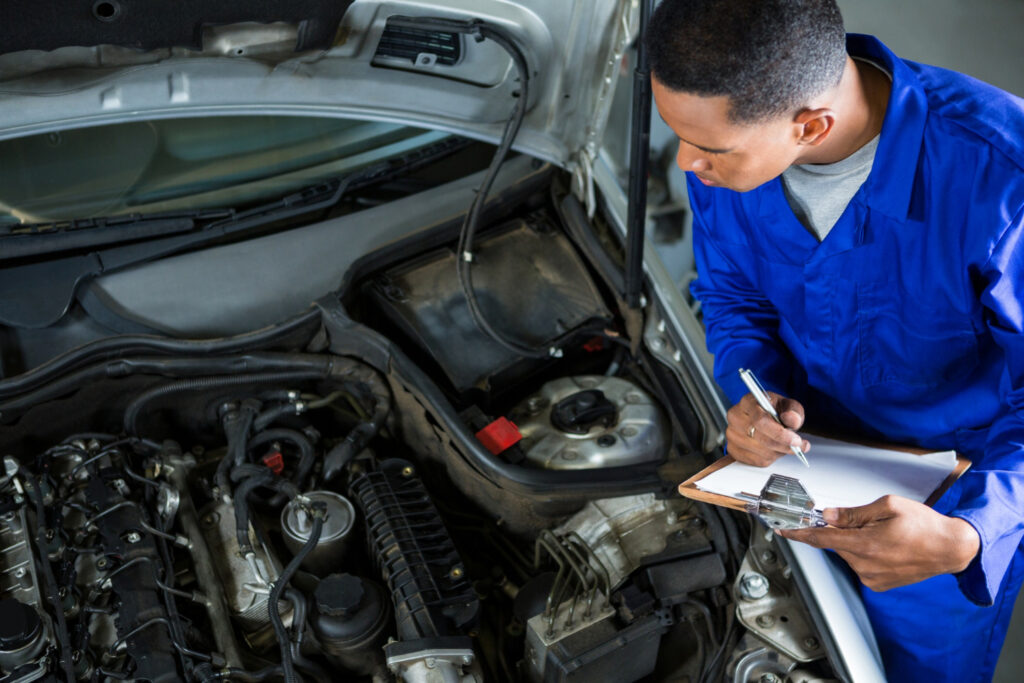
One of the biggest unknowns for first-timers is what the inspection itself feels like and what happens. In reality, it is a structured, guided process where you are told exactly what to do at each stage. However, don’t expect staff to speak English (many do speak a little, though).
You will usually stay in your car throughout the test. An inspector will guide you using a combination of gestures and short instructions, which can feel intimidating if you don’t speak Spanish — but in practice, it is easy to follow.
The process typically includes the following stages:
Initial Check and Identification
Your documents are reviewed, and the vehicle details are confirmed. The inspector ensures that the registration, VIN number, and paperwork match. This is often started at the front desk, where you are then assigned a lane to drive your car through (if there are multiple lanes), although the VIN may also be physically checked again during the inspection itself.
Lights and Electrical Systems
You will be asked to turn on different lights: dipped beam, full beam, indicators, brake lights, hazard lights, reverse light, and sometimes fog lights.
The inspector will also check headlight alignment using a machine and look at your dashboard to ensure there are no warning lights showing (such as engine, ABS, or airbag lights). This is one of the most common failure points, often for something as simple as a blown bulb or a warning light left on.
Brake Testing
You will drive onto a set of rollers. When instructed, you press the brake pedal. The system measures braking force and balance between wheels. Uneven braking can result in a failure.
Suspension and Steering
The vehicle is placed on moving plates that shift the wheels slightly. This allows the inspector to detect looseness or instability in suspension and steering components, such as worn joints or excessive play.
Undercarriage Inspection
Your car is usually driven over a pit rather than lifted. From below, the inspector checks the underside of the vehicle using a light.
They are looking for leaks, rust or structural damage, issues with the exhaust system, and worn or loose components.
Emissions Testing
A probe is inserted into the exhaust to measure emissions.
For petrol cars, this involves testing at idle and higher revs. For diesel vehicles, the engine is revved more aggressively. High emissions are a common cause of failure, particularly for older diesel cars.
Tyres and Wheels
The inspector will check your tyres for overall condition, tread depth, and that they are appropriate for the vehicle. They will also look for uneven wear, damage, or mismatched tyres across the same axle.
Tyres are one of the most common reasons vehicles fail the ITV, so it is worth checking them carefully beforehand.
General Safety Check
Seatbelts, mirrors, horn, and other basic safety features are tested. The inspector will also check tyre condition and tread depth, which is another common reason vehicles fail.
The entire process usually takes between 10 and 20 minutes.
Why Cars Fail the ITV (and How to Avoid It)
Most ITV failures are not due to catastrophic problems. They are usually caused by small, preventable issues.
One of the most common reasons is faulty lighting. A single non-functioning bulb is enough to fail the inspection. This is easily avoided by checking all lights beforehand.
Tyres are another frequent issue. While the legal minimum tread depth is 1.6mm, tyres close to this limit are more likely to be flagged. Uneven wear can also cause problems.
Dashboard warning lights are taken seriously. If your engine management light is on, you should assume the vehicle will fail.
Emissions are a common problem, especially for diesel cars that are mainly used for short journeys. These vehicles often accumulate carbon deposits, which lead to higher emissions readings.
Oil leaks, even minor ones, can also result in a failed inspection. Inspectors are looking for signs that could indicate mechanical problems or environmental risks.
What Happens If You Fail
Failing the ITV is not the end of the world, but it does come with restrictions.
You will receive a report detailing the faults. These are categorised as minor or serious. Minor faults do not prevent you from passing, but serious ones do.
If your vehicle receives a “desfavorable” result (fail), you must fix the issues and return for a retest. You usually have up to two months to do this, and the retest is often free if you return to the same station.
However, there is an important restriction: you are only allowed to drive the vehicle to a garage and back to the ITV station. It is not considered roadworthy for general use.
Must-know Spanish Terms for the ITV
While you can get through the process without speaking much Spanish, understanding a few key terms makes everything smoother.
You will often hear:
- “Cita previa” – appointment
- “Inspección” – inspection
- “Apto” – passed
- “Desfavorable” – failed
- “Frenos” – brakes
- “Luces” – lights
- “Neumáticos” – tyres
- “Emisiones” – emissions
If you are unsure about something, it is perfectly acceptable to say that you do not speak much Spanish. Inspectors are used to dealing with expats and will usually communicate in simple, clear ways. And of course, Google Translate is always your best friend!
Practical Tips to Pass First Time
Preparation makes a significant difference.
A simple pre-check before your appointment can save you from an unnecessary failure. Test all your lights, check your tyres, and make sure there are no warning lights on the dashboard.
Driving the car for 15–20 minutes before the test is particularly important for emissions. A warm engine produces more accurate and often lower emission readings.
If your car is older, it can be worth having a mechanic do a quick pre-ITV check (revisión pre-ITV, as it’s called in Spanish). You’ll often see garages advertising this service, and it is especially useful if you are not confident in identifying potential issues yourself. Note that the pre-ITV check isn’t an official inspection; it’s just a basic check by a mechanic to catch common failure points like lights, brakes, tires and emissions issues.
Even small details can help. A reasonably clean car makes inspection easier and gives the impression that the vehicle is well-maintained.
Costs and What to Expect
The cost of an ITV in the Canary Islands is relatively modest compared to many other countries.
Petrol cars typically cost between €35 and €45, while diesel vehicles are slightly more expensive due to the emissions test.
Payment is usually made at the station, either before or after the inspection, depending on the setup. You can also book and pay online, generally with a discount.
To sum things up…
The ITV process in the Canary Islands is one of those things that feels intimidating until you’ve done it once. After that, it becomes routine.
The key is understanding that this is not a test designed to catch you out. It is a structured inspection with clear criteria. If your car is well-maintained and you take the time to prepare, passing is entirely achievable.
For expats, the added challenge of language can make the experience feel more stressful than it needs to be. But in practice, the process is visual and guided. You are shown what to do at each step.
Approach it calmly, prepare your vehicle in advance, and treat it as part of normal car ownership in Spain. Do that, and the ITV becomes just another simple task rather than something to worry about. ¡Suerte!